- What the science says
Every December, we see the same headlines: ‘How to stop your dog misbehaving over the holidays’ or ‘Surviving festive chaos with your dog.’ The language matters, because these dogs aren’t misbehaving at all.
They are coping.
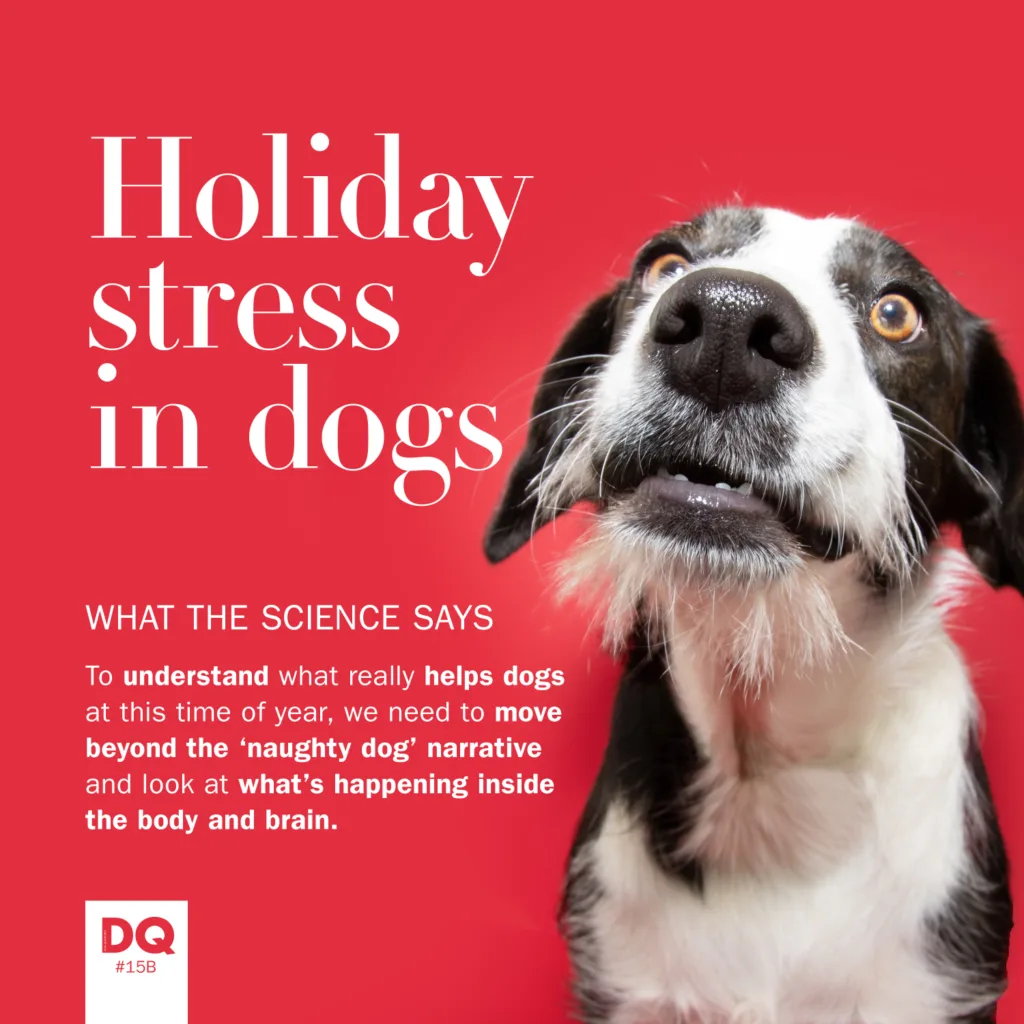
Holiday stress in dogs isn’t about poor training or bad manners. It’s about physiology, arousal, and disrupted recovery in an environment that suddenly becomes louder, busier, hotter, and far less predictable. To understand what really helps dogs at this time of year, we need to move beyond the ‘naughty dog’ narrative and look at what’s happening inside the body and brain.

Stress is a biological process
When dogs encounter stressors, noise, novelty, separation, travel, social pressure, their bodies activate the hypothalamic–pituitary–adrenal (HPA) axis, releasing cortisol and adrenaline. In the short term, this response is adaptive. It helps a dog stay alert, mobile, and responsive.
The problem comes when stressors occur repeatedly, when recovery time is insufficient, and when arousal remains chronically elevated. This is where holiday stress becomes cumulative rather than momentary. What looks like a dog ‘acting out’ is often a nervous system trying desperately to regulate itself under conditions that make regulation nearly impossible.
Cortisol
Cortisol is often misunderstood. Unlike adrenaline, which spikes and vanishes, cortisol lingers. Research shows that cortisol levels can remain elevated for hours or even days after a stressful event, especially if the dog is exposed to multiple stressors in close succession.
This has profound implications for how we think about holiday schedules. Last night’s fireworks, followed by a house full of guests, followed by a car trip the next day, aren’t separate events to a dog’s nervous system. They stack. Each new stressor lands on top of the last, building a physiological load that doesn’t simply evaporate when the immediate trigger disappears.

Arousal stacking
Arousal stacking refers to the accumulation of physiological and emotional stress without adequate recovery in between. Think of it like filling a bucket. A single stressor might only add a cup of water, but when you keep adding more without giving the bucket time to drain, eventually it overflows.
A dog experiencing arousal stacking may show restlessness, irritability, reduced impulse control, increased reactivity, difficulty settling or sleeping, and even gastrointestinal upset. Importantly, this is not defiance or regression but rather a nervous system that hasn’t had the chance to reset.
Holiday schedules often remove the very things that help dogs regulate: predictable routines, quiet rest periods, familiar environments, and uninterrupted sleep. Dogs are expected to be flexible and adaptable during the exact period when their capacity for flexibility is most compromised.

Sleep disruption
Sleep is when dogs process stress and restore balance in their nervous systems. It’s not simply downtime, but active recovery. During the holidays, though, dogs often sleep later than usual, sleep in different locations, experience fragmented sleep due to noise, heat, or movement, and nap less during the day.
Studies in both animals and humans show that sleep deprivation increases cortisol, reduces emotional regulation, and lowers stress thresholds. A tired dog is not a resilient dog. When we keep dogs up late for festivities or wake them repeatedly throughout the night, we’re not just interrupting their rest; we’re actively undermining their ability to cope with everything else the season throws at them.
Which stressors matter most?

Not all holiday stressors affect dogs equally. Based on behavioural research and clinical observation, fireworks tend to rank as the most impactful. They’re high-intensity, unpredictable, and completely uncontrollable from the dog’s perspective, triggering a strong physiological stress response that can take days to resolve fully.
Travel comes next, bringing confinement, motion, temperature changes, and unfamiliar environments. This is moderate to high stress for most dogs, and especially challenging for those prone to nausea or anxiety. Then there are parties and guests, which create social pressure, noise, and loss of safe space. The stress here is highly variable and depends heavily on the individual dog: some thrive on social interaction, while others find it overwhelming.
Decorations and novelty, the visual changes and new smells that come with festive preparation, usually register as low stress unless paired with other factors. But here’s the key point: it’s rarely just one thing. It’s the combination, the timing, and the lack of recovery between events that tips dogs from coping to struggling.
Calm enrichment vs distraction

Many well-meaning owners respond to holiday stress by offering more toys, more games, more activity, more novelty. The thinking goes: if my dog is stressed, I’ll keep them busy and distracted. But stimulation is not the same as regulation.
Distraction-based enrichment increases arousal, keeps the dog busy rather than calm, and can actually worsen stress in already activated dogs. It’s like trying to help an overtired toddler settle down by taking them to a theme park: you might exhaust them eventually, but you’re working against their physiology, not with it.
Calm enrichment, on the other hand, supports nervous system downregulation. It encourages settling and self-soothing, working with physiology rather than against it. This includes activities like sniffing and foraging, which tap into dogs’ natural behaviours and lower arousal. Licking, whether from frozen Kongs, lick mats, or other appropriate items, has a similar effect, as does appropriate chewing. The rhythm and repetition of these activities help dogs self-regulate.
Gentle, predictable routines and quiet companionship also fall into this category. Sometimes the most helpful thing we can offer a stressed dog isn’t entertainment; it’s simply our calm presence and the permission to rest.
What actually helps (and what doesn’t)
Maintaining routine where possible makes an enormous difference. While holiday schedules inevitably shift, keeping meal times, walk times, and sleep times as consistent as possible gives dogs anchors in the chaos. Providing quiet rest spaces, places where dogs can retreat and won’t be disturbed, is equally crucial. This might mean setting up a bedroom or quiet corner as a dog-only zone during gatherings.
Calm enrichment activities like sniffing and licking help far more than high-energy ‘distraction’ toys that ramp up arousal. Predictable walks and rest times support regulation better than the common approach of over-exercising dogs to ‘tire them out’, which often just creates tired, wired dogs with even less capacity to cope.
Proactive stress management beats waiting until stress escalates. This means recognising early signs and intervening before your dog reaches their threshold. Allowing dogs to opt out of interactions respects their communication and prevents situations from deteriorating. Avoidance is a coping strategy, not misbehaviour. Recognising this distinction helps prevent situations from escalating.
Supporting sleep and downtime is non-negotiable, yet it’s often the first thing that disappears during the holidays. Late nights and noisy environments might be part of human celebration, but for dogs they’re stressors that compound everything else. Finally, vet- or behaviourist-guided support is far more valuable than one-size-fits-all advice from social media or well-meaning friends (or even magazines!). Every dog is different, and what works brilliantly for one may backfire for another.
The most important reframe
Holiday stress doesn’t mean your dog is untrained, difficult, spoilt, or regressing. It means their environment changed faster than their nervous system could adapt. The most effective response is predictability, adequate rest, and reduced pressure rather than increased control.
In a season full of noise and expectation, calm isn’t a luxury for dogs, it’s a biological necessity.