KUSA’s new scent work discipline
Few people are better placed to explain a new South African dog sport than a person involved in drafting the rulebook.
Claire Patterson-Abrolat has just moved into a new role at the Kennel Union of Southern Africa as its Communications and Public Relations Lead, after four years running Club Affairs. Among the responsibilities she carries into the new job is the updating and publishing of KUSA’s Schedules, the regulations governing every licensed dog sport in the country. Schedule 11B, which sets out the new scent work discipline element by element and level by level, is one of them.
She comes to dog sports as a competitor as much as an administrator. She has had multiple champions across several branches of dog sports, won national titles, and competed in Europe with one of her dogs. She is a qualified judge in eight disciplines: Working trials (classic), Tracking trials, Obedience, Rally dog, Agility, Hoopers, Canine Good Citizen and Trick dog.
Dogs are one of two careers. The other is conservation, where she has spent more than thirty years and holds an MPhil in environmental ethics. For several of those years she managed bird and wildlife control programmes at airports, work that put dogs on the payroll!
We asked her about scent sports, and about the new discipline KUSA is bringing to South Africa.
We’re incredibly grateful for her insights and look forward to seeing the new discipline launched here in South Africa.
DQ: For readers who have never tried organised dog sport, what exactly is scent work, and why is
it a good sport to try?
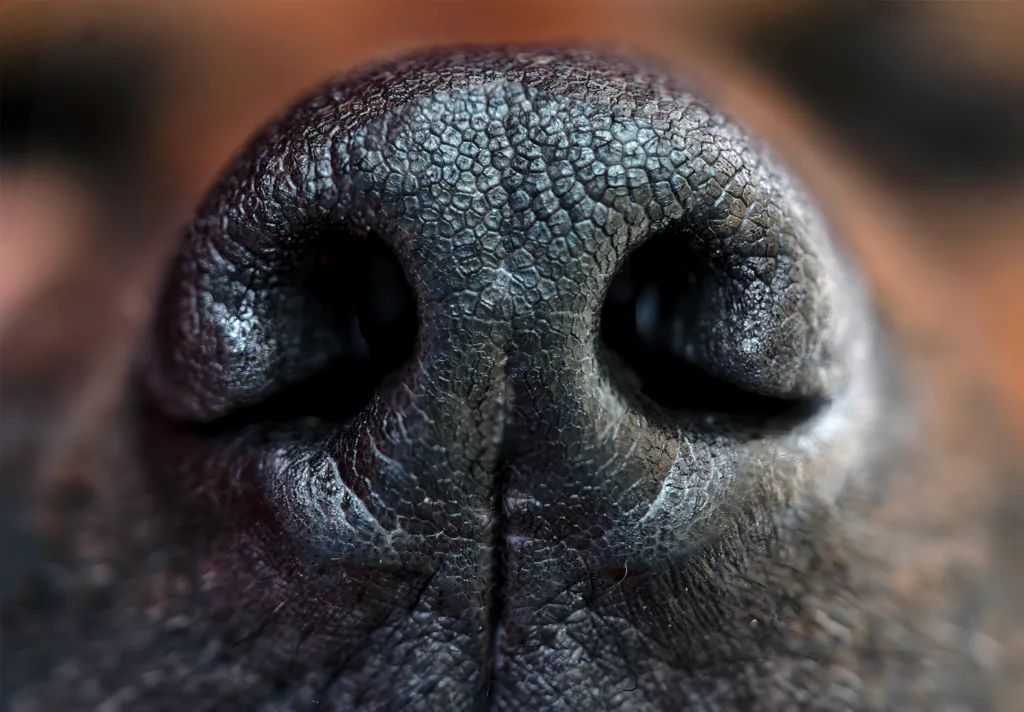
Claire: Sniffing is a completely natural and instinctive behaviour for dogs; when puppies are born, the first thing they do is use their noses to find their mom’s teat and suckle. Dogs love using their noses; just think of how often they stop and sniff items when out on a walk. Scent sports enable dogs to utilise this natural behaviour and instinct in a fun way that leads to mental stimulation and builds a relationship with you as their companion.
There are four basic elements to KUSA’s Scent Work tests; a search using just 10 containers, a search indoors, a search outdoors and one where the articles are ‘buried’ lightly under sand or placed in water. Each of these components has four levels of difficulty, meaning new handlers and dogs can start out with low complexity and build up through the levels and types of searches, as adeptness increases.
DQ: What does scent work give a dog, both mentally and physically?
Claire: Scent exercises require a dog to focus on scents and analyse them; if you think of them sniffing on a walk, they are not just determining whether another dog had passed by, but through smell they can analyse when the other dog was there, whether it was big or small, male or female, friendly or hostile, etc. All this analysis really stimulates a dog mentally and can tire them out in a way that just throwing a ball, and generally building fitness, can’t. A dog that is mentally stimulated is likely to display fewer behavioural problems, such as digging or chewing objects at home.
DQ: What kind of dogs is scent work most suitable for?
Claire: All dogs have noses and are therefore capable of doing scent sports. The propensity to smell is not breed-specific or confined to purebred dogs. Some breeds, for instance, Bloodhounds, have been specifically bred for scenting, but all dogs are capable of detecting and marking scent.
Disciplines
DQ: KUSA runs several scent-based disciplines. Could you give us a quick map of the main ones, working trials, tracking trials, field trials and the new scent work, and how they differ from one another?
Claire: KUSA’s various branches of Dogsport that include scent exercises include:
• Tracking Trials – this sport consists only of tracking. Essentially, someone walks through the veld, and the dog is required to follow the track and find the articles dropped along the way. Tracks are laid on cut veld grass (or grass specially planted for animal fodder), a ploughed field or grass being grown at lawn farms. The dog works the track anything from 30 minutes to 180 minutes after the tracklayer has laid the track, depending on the level the dog is competing at. The complexity varies from 2 corners to up to 7, which may be of any angle and may even include curves. It is a fun but demanding sport where accuracy is key. Although open to any breed or crossbreed, the dog must be registered on one of KUSA’s registers.
• Working Trials (Classic) – dogs move up the ranks from Companion Dog to Tracker Dog I, II and III. There is also a Police Dog stake. Each class consists of two to four ‘groups’ of exercises: a Control Group (heelwork, send away, recall, retrieve, stay and gunshot steadiness), an Agility Group (A-frame, long jump and clear jump) and a Nosework Group, which includes exercises such as an area search (dog to bring one to four articles out an area 25x25m), a Search and Identify (dog to find and bark next to a largish item hidden in an area 100x100m) and a track of from 4 to 10 corners and up to 800m in length. The Police Dog stake also includes various protection exercises. While any dog registered with KUSA can take part, it does require a high degree of fitness and versatility as dogs must perform, and pass, all exercises on the day.
• FCI-IGP (Internationale Gebrauchshundeprüfung) – consists of an entry-level test known as BH and then FCI-IGP I, II and III. While the BH is open to all dogs, the IGP levels are only open to breeds such as German Shepherd Dogs, Belgian Shepherd Dogs, Rottweilers, Dobermanns, etc. The FCI-IGP levels consist of an Obedience Group (stays, heelwork, retrieves over jumps etc.), a Protection Group and a Tracking Exercise. Tests are usually conducted over two days with the predominant emphasis on precision.
DQ: The new scent work discipline launching later this year sounds like a real milestone. What will it involve, how does detection-style work differ from following a trail, and when and where might readers first be able to take part?
Claire: KUSA is really excited about launching this new sport, which is based on detection-type exercises. It will see two streams – one where the handler uses their own scent and another where dogs must find certain essential oil scents such as cypress, anise, clove and vetiver. Within each stream, there are four elements – container, indoor, outdoor and buried. Moreover, each element has four levels of difficulty.
Unlike tracking, where the principles of Search and Rescue are mimicked with the dog following a trail to find a missing person or a suspect running away, Scent Work is more aligned with detection activities such as the drug-sniffing dogs at airports or bomb-detection dogs used by the military. Handlers can choose if they want to do all four elements with their dogs or just follow one to its highest skill level. However, achieving three qualifications in at least three elements at the highest level will see the dog achieving the status of Grand Champion.
We are hoping that competitions will be on offer from as early as October, but definitely by 2027. We are finalising the material to ensure the Judges are fully qualified and ready to qualify teams that perform successfully.
Getting started
DQ: If a curious owner wanted to try a little scent work at home this weekend, what could they do, and what basic kit would they need?
Claire: To start your dog scenting and searching, take his or her favourite toy and hide it in the garden (or bedroom, kitchen, etc). Start in a small area, let the dog see where you are placing it, and verbally encourage them to find it. When they do, praise enthusiastically. Do this several times until the dog understands what ‘find’ means. You can then up the game by not letting your dog see where you’ve hidden the toy but still asking them to search in a relatively small area. This builds enthusiasm for searching. However, in Scent Work you will want your dog to indicate the location of an article, not retrieve it, so you need to also teach the end-behaviour, which is to sit or ‘down’ when the article is found.
Separately from the above, which is just aimed at building enthusiasm, place the toy in a container with a lid with holes in it (cardboard box or old ice-cream tub) and when the dog walks over to sniff it, reward them. Encourage them to hold the position, so you can be sure, on test day, that they have found the hidden scent.
When training by oneself, the biggest challenge is that of scent contamination. For example, if I’m training my dog to do container scent, and I put out a few boxes and hide an article with my scent in one, all the boxes will actually smell like me because I put them all out so which one should the dog indicate? It is very easy to confuse a dog this way. Rather, invest in a pair of tongs or rubber gloves to avoid touching the articles. To start with, you will want some containers such as ice-cream tubs or cardboard boxes for the container search. For indoor and outdoor searches, you will need a small tube into which to place the scent. Initially, it doesn’t really matter what you use (although the essential oils can degrade plastic). Be careful with glass tubes or metal, which may get hot out in the sun.
DQ: How does someone find a club, class or trainer near them, and is provision spread across the country or concentrated in particular areas?
Claire: They are welcome to get in touch with KUSA, and we can put them in touch with someone in their area. Most of the major centres have trainers or people willing to assist. A few schools can also be found on social media, such as Facebook.
DQ: What does the path into competition look like for someone who gets hooked?
Claire: Your trainer can best advise you on this when the time comes that you are ready to enter. To register your dog, you can search on the KUSA website for the applicable application form. Upcoming Shows (competitions) are also listed under Events > Events Calendars, or you can research them using the search button on the right.
Big picture
DQ: You mentioned huge potential for scent work in South Africa. Where would you love to see it in a few years, and what would help it get there?
Claire: We would love to see more dogs and handlers getting involved in the sport. It offers so many benefits for dogs, invigorating and stimulating them and enhancing their bonds with their companions. It is neither a physically demanding sport nor one that requires a lot of expensive equipment; it’s accessible to people from all walks of life. The environment required by the searches means that competitions can take place in a variety of places, e.g. the indoor searches can be held in warehouses, office blocks to storerooms, whereas outdoor searches can take place in a park, a piece of veld, or someone’s garden – wherever you have permission to gain access and where it is safe for the participants and spectators.
Who are KUSA?
The Kennel Union of Southern Africa is the country’s national canine organisation. It was founded in 1891 out of two older clubs, one in Port Elizabeth and one in Cape Town, and it celebrated its 125th year in 2016.
KUSA does LOTS of different things, but three main things that are relevant to this article. Firstly, it registers dogs. Secondly, it licenses shows and trials and thirdly, it writes the rulebooks, called Schedules, for every recognised dog sport in the country, from breed showing and agility through to obedience, tracking and now scent work.
KUSA is a member of the Fédération Cynologique Internationale, the world’s largest canine federation, which is why South African working qualifications carry weight internationally.