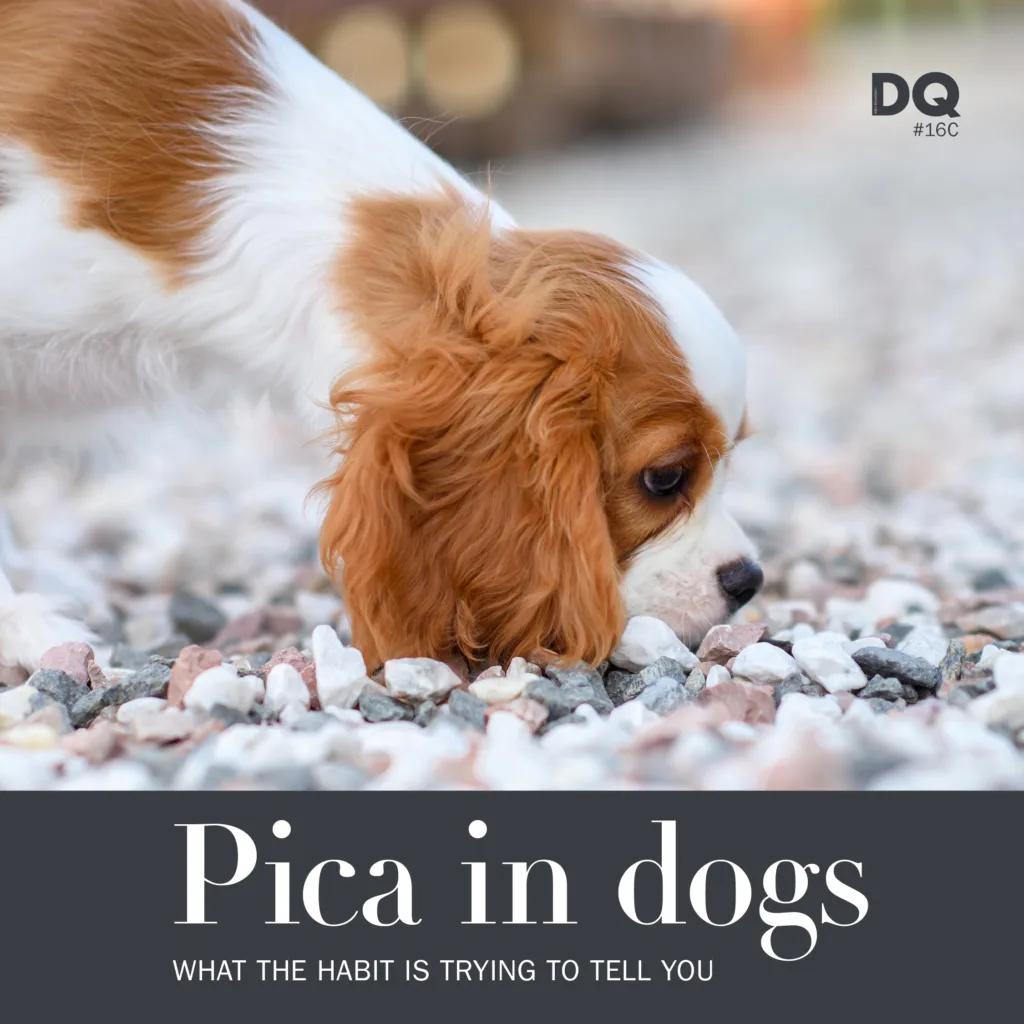
What the habit is trying to tell you
Eating non-food objects is rarely just a bad habit. The pattern, and the dog’s age, often point to the real problem.
Most of us meet pica as a bit of a nuisance and something we need to ‘train out’ of the behavioural repertoire. Our dog swallows a sock, shreds a cushion, works through the corner of a rug, and the question that follows is almost always ‘How do I get it to stop?’ Sadly, it is the wrong question, or at the very least an incomplete one.
Pica, the repeated eating of things that are not food, is a symptom rather than a diagnosis in itself. The more useful question, then, is what the behaviour is pointing to, because the answer changes everything about what we should be doing next.
When it might be medical
The first job is to separate a behavioural problem from a medical one, and here, a dog’s age does much of the work. A young dog that has always been mouthy and indiscriminate is a different proposition from a settled adult or senior that suddenly develops the habit.
A 2026 study in the American Journal of Veterinary Research makes the point clearly. Researchers reviewed 313 dogs that had surgery to remove a swallowed object. Among dogs under eight, fewer than eight per cent had unrelated abdominal disease discovered during the operation. Among dogs aged eight and over having their first such surgery, that figure was almost 57 per cent. In other words, when an older dog eats something it should not for the first time, the odds are roughly even that the surgeon finds something else going on, often the very thing that prompted the behaviour.
Did you know?
Among dogs aged eight and over having their first foreign-body surgery, almost 57 per cent had unrelated abdominal disease found during the operation, against fewer than eight per cent of dogs under eight.
That is why a new pica habit in an adult or senior dog warrants a proper veterinary work-up rather than a training plan. In older dogs with no behavioural history, conditions such as anaemia, liver disease, hormonal disorders and chronic gut disease are all recognised contributors that could lead to the development of the condition. A vet may run blood work, check folate and cobalamin levels, assess pancreatic function and image the abdomen, not because pica is always medical, but because the cost of missing a treatable illness is high.
The pattern is information
Once medical causes are addressed or ruled out, the style of the behaviour itself carries more detail than many of us realise. This means that it is worth watching not just whether a dog eats objects, but how.
A French study compared 42 dogs that had swallowed foreign objects with 42 matched dogs that had not. In that group, the ingestion was far more often driven by a behavioural abnormality than by gut pain, roughly 88 per cent against 12 per cent. More usefully, the style of the behaviour tracked with the cause of the pica. Dogs that shredded objects tended toward hyperactivity and poor impulse control, while dogs that swallowed without shredding were more likely to be driven by anxiety or an over-attachment to their owner. It is a small study, so the percentages should be taken lightly, but the principle is clinically familiar: a frantic shredder and an anxious sock-swallower are not the same dog, and they do not need the same plan.
Some of these dogs fall under what veterinary behaviourists call hypersensitivity-hyperactivity syndrome, a developmental picture loosely comparable to ADHD in people. These dogs often never learned to inhibit their bite as puppies, struggle to stop a behaviour once they have started, and react to ordinary background stimulation that other dogs ignore. Naming it matters because it reframes the dog from ‘badly behaved’ to ‘wired differently,’ which in turn points toward management and, sometimes, medication, rather than just a ‘no’.
Why ‘just stop it’ backfires
The instinctive response, telling the dog off or shutting them away when they offend, tends to make things worse. Punishment raises anxiety, and anxiety is one of the engines of the behaviour, so the correction can feed the very loop it is meant to break.
What helps depends on what is driving the non-nutritive eating. For the impulsive, under-stimulated dog, the work is in finding outlets for the behaviour: predictable exercise, sniffing and foraging games, chew items that are actually satisfying, and management that removes temptation while the rest is built. For the anxious dog, the work is in lowering the background load, with routine, gradual exposure and, where appropriate, medication prescribed and monitored by a vet.
When to act fast
Treat pica as urgent, and call your vet, if you notice any of the following: a sudden new habit in an adult or senior dog; repeated vomiting, refusal to eat, a tense or painful belly, or unusual lethargy; known or suspected swallowing of something sharp, or long and stringy (linear items such as thread, tights or rope are especially dangerous); or straining with no stool. When a blockage is possible, hours matter in saving the dog’s life.
Final thoughts
The practical takeaway is as follows.
Treat a sudden pica habit, especially in an older dog, as a medical question first and a behavioural one second. Then once a medical cause is ruled out or considered unlikely, you need to watch the pattern, because it tells you which kind of behavioural problem you are dealing with. In South Africa, board-certified veterinary behaviourists are thin on the ground, so the realistic route is usually your own vet for the medical work-up, then a referral or a suitably qualified, force-free behaviour consultant for the rest. It’s a slow fix, but there is no reliable quick fix. Ultimately, pica responds to the right diagnosis not a louder ‘no.’