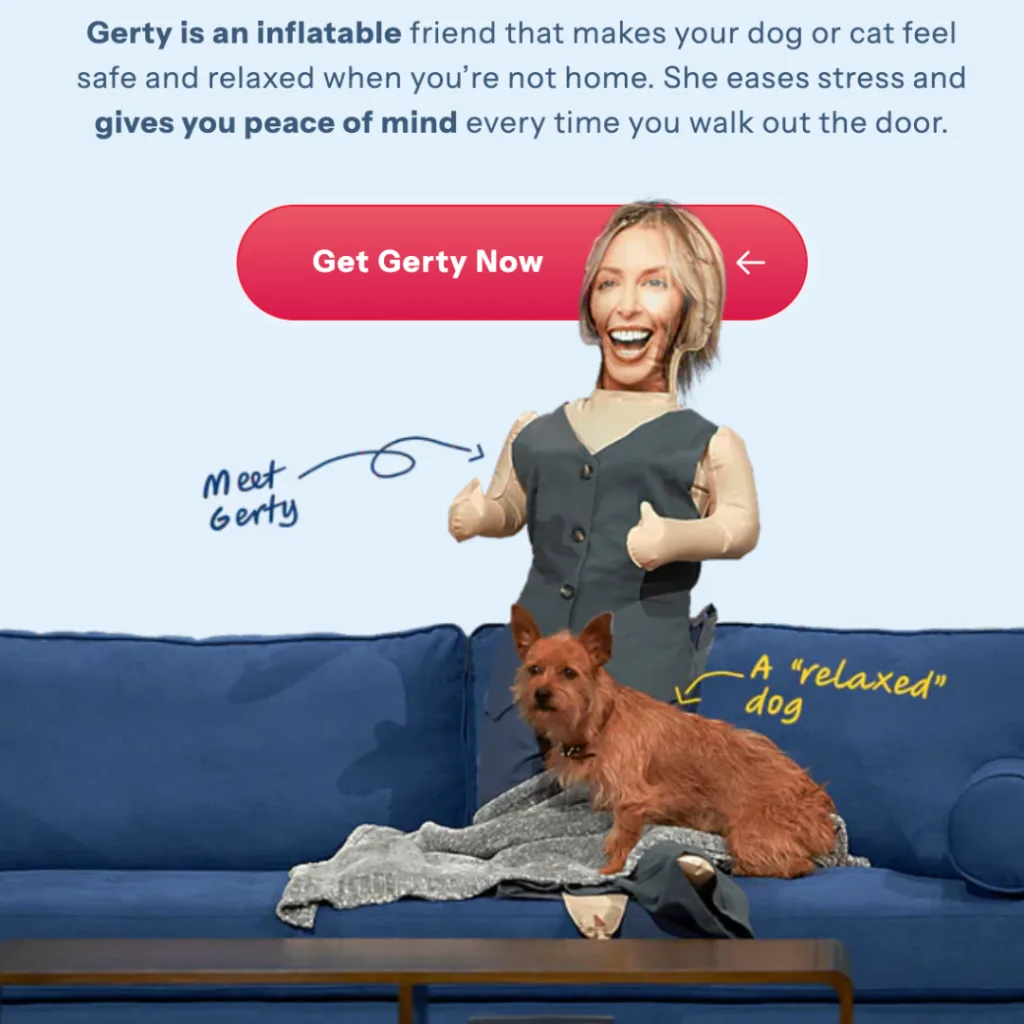
Every so often, a product comes along that is so strange it travels the internet on its own steam. Meet Gerty: a life-sized, inflatable, human-shaped doll that you stand in your living room so your dog believes a person is home. The doll has a wide smiling face, soft vinyl arms a dog can curl up under, and, yes, you can pay extra to have your own face printed on it.
It went viral for a reason. When its inventor, hospitality entrepreneur Todd Schram, pitched it on the American show Shark Tank in late 2025, the investors first burst out laughing, and one joked that he was not sure he wanted to be in the blow-up doll business. Schram won over Kevin O’Leary all the same, walking away with a fifty-thousand-dollar deal for a thirty percent stake, and the clips promptly became a meme. On the face of it, the whole thing is quite ridiculous.
Underneath the absurdity, though, is a real problem, and we wanted to take a look at whether Gerty actually can serve a purpose.
The idea, and where it came from
The concept is not quite as mad as it looks. Schram says the idea came from his own rescue dog, Hamlet, who panicked whenever he left the house until, out of desperation, he left a pile of his worn laundry on the dog’s bed and Hamlet settled beside it. Gerty is a scaled-up version of that instinct. You dress the doll in your worn clothes so it carries your scent, introduce it to your dog slowly over a day or two as though it were a real person, and the idea is that your dog feels less alone with a familiar-smelling, human-shaped presence in the room.
This much, sort of, makes sense to us. Scent and a sense of company genuinely do soothe some dogs, which is exactly why a worn jumper, a radio left on, or a favourite stuffed toy can take the edge off for a mildly unsettled dog. Gerty is that same principle, inflated to human size.
Separation anxiety
Separation anxiety is one of the most commonly reported behaviour problems in dogs, and it is genuinely distressing, for both the dog and the owner. A dog in real separation distress is panicking: barking and howling, pacing, destroying doors and furniture, toileting indoors, sometimes injuring himself trying to escape. Owners come home to chaos and to a dog that has clearly suffered, and they will, understandably, try almost anything. That desperation is precisely the market Gerty is speaking to.
So, does it work?
Here is where we have to be straight. The evidence that Gerty works is, at this stage, entirely anecdotal. It rests on Schram’s own dog, on before-and-after videos, and on customer testimonials. The marketing goes further, describing the doll as scientifically designed and claiming it succeeds for around eighty percent of pets, but there is no published research behind those figures, and a media mention is not the same as scientific validation. As Schram himself jokes, Gerty is 96 percent vinyl and 4 percent magic. That is a good line, and also a fair admission that this is not a clinically tested treatment.
At best, then, a doll like this belongs in the same box as a scent-soaked t-shirt or a calming toy: a management aid that might take the edge off for a mildly anxious dog. It is not a treatment for genuine separation anxiety, and there is no good evidence it resolves the underlying condition.
What actually helps
For a truly anxious dog, the approach with real evidence behind it is less inflatable. Separation anxiety is a learned panic response, and the way to change it is to teach the dog, in very small increments, that being alone is safe. That means gradual desensitisation to the things that signal you are leaving, counter-conditioning so that your departure predicts good things rather than abandonment, and building up alone-time slowly rather than flooding the dog with hours he cannot cope with. For many dogs, especially in severe cases, that work is best done with a vet or a qualified behaviourist, and sometimes alongside medication to reduce the panic enough for the training to work. Management aids, scent items, food puzzles, enrichment, calming products, can support that process, but they do not replace it.
The honest risk with a product like Gerty is not that it is silly. It is that a desperate owner spends the money, believes the problem is handled, and quietly delays getting real help while the dog carries on suffering.
The verdict
So we definitely enjoyed the absurdity, because it is genuinely funny, and if dressing a scent-carrying object helps your dog feel a little less alone, there is no harm in it as one small part of a proper plan. But a slightly terrifying, smiling vinyl figure is not a substitute for the real, unglamorous work of helping a dog suffering from separation anxiety. For a dog in genuine distress, that work, ideally guided by a behaviourist or your vet, is where your effort and your money belong.