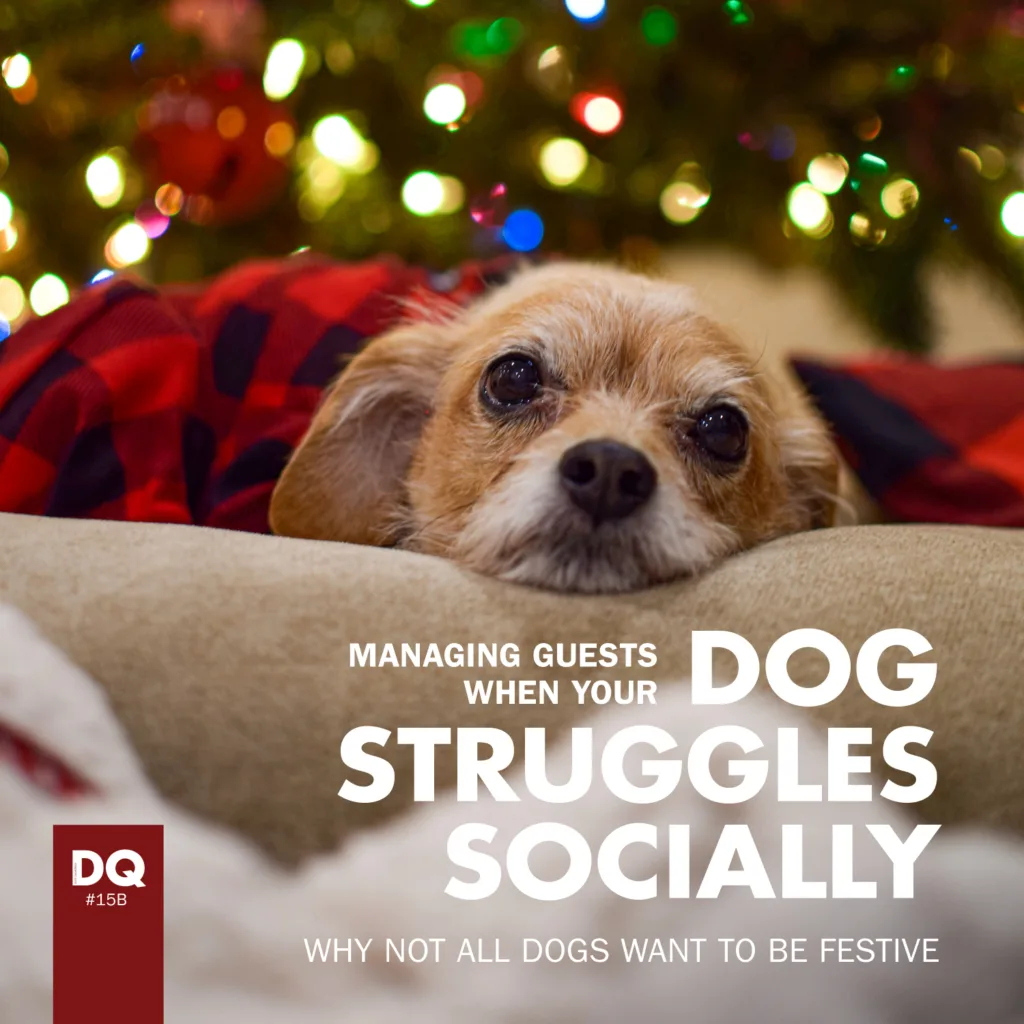
Why not all dogs want to be festive
The holidays bring people together, but for many dogs, a house full of guests is not a celebration. It’s noise, unpredictability, lost routines, unfamiliar scents, and pressure to engage in ways that feel overwhelming or threatening.
When dogs struggle socially during busy periods, it’s never about poor manners and rarely even about inadequate training. It’s normally about overstimulation, fear, or both, and recognising the cause is key to preventing distress and protecting your dog’s wellbeing.
Overstimulation vs fear
Although the behaviours can look similar on the surface, overstimulation and fear are driven by different internal states and require different management approaches. Confusing the two can lead to strategies that inadvertently worsen the problem.
Overstimulation is often seen in dogs who are sensitive to movement and noise, struggle to settle even in familiar environments, and become excitable, jumpy, or mouthy when arousal levels climb. Behaviour may include pacing back and forth, barking at every sound or movement, difficulty lying down and staying down, and impulsive interactions in which the dog seems unable to control his responses.
Overstimulated dogs are not necessarily afraid; they are overloaded and unable to regulate. Their nervous system is running too hot, and they lack the internal resources to downshift. Think of it like being over-caffeinated: everything feels urgent, nothing feels comfortable, and self-control becomes nearly impossible.
Fear-based responses, by contrast, are rooted in perceived threat. The dog’s nervous system has shifted into defensive mode, prioritising survival over everything else. Behaviour may include avoidance or hiding, sometimes in surprisingly creative places. Freezing – going very still in the hope of not being noticed – is a common but often missed sign. Growling or snapping when approached represents escalated communication, usually because earlier signals were ignored. Trembling or excessive panting reflects the physiological activation of the fear response.
Fear escalates when dogs feel trapped, pressured, or ignored. When a fearful dog’s attempts to create distance are blocked or punished, they may move up the ladder of aggression, not out of malice, but out of desperation.
Mistaking fear for overstimulation, or vice versa, can lead to management strategies that make things worse. An overstimulated dog doesn’t need more space and quiet (though they won’t be harmed by it); a fearful dog absolutely requires it. A fearful dog forced into social interaction can become dangerously defensive, while an overstimulated dog simply becomes more chaotic.

Why social pressure increases stress
Dogs do not experience hospitality the way humans do. They don’t feel joy at a full house or pride in being good hosts. Being expected to tolerate touching from strangers, engage with unfamiliar people who may smell, sound, and move differently from anyone they know, and remain ‘polite’ while emotionally and sensorially overwhelmed adds social pressure to an already demanding environment.
Stress compounds when dogs are unable to retreat to safety, repeatedly approached despite clear avoidance signals, restrained while visibly uncomfortable (being held for patting, blocked from leaving a room), or corrected for communicating their distress through growling or moving away. Punishing warning signs doesn’t eliminate fear—it removes the dog’s ability to communicate distress. The fear remains while the communication stops, which increases bite risk.
Crate myths
Crates are often misunderstood, viewed either as essential tools or as cruel confinement, depending on who you ask. The reality is more nuanced and depends entirely on the individual dog’s relationship with the crate and how it’s being used.
Crates are helpful when the dog has been positively conditioned to view the crate as a den, when the crate is always a choice rather than a punishment, when it’s placed in a quiet, low-traffic area away from the chaos, and when guests are clearly instructed not to disturb the dog or interact through the bars.
Crates become harmful when the dog is confined while already distressed, when guests lean over to look at or talk to the dog through the crate, when the crate becomes a ‘timeout’ for unwanted behaviour, or when the dog cannot leave if they become overwhelmed. A crate should represent relief, not restriction. It should be the place a dog actively chooses when things feel too big, not the place they’re put when they’ve ‘misbehaved.’
For dogs who dislike crates, become more anxious when confined, or have negative associations with crating, an alternative safe space, such as a bedroom with the door closed, a study where they can observe from a distance, or even a quiet corner behind a baby gate, may be more appropriate. The goal is refuge, not confinement.

What actually helps during this period
Predictable daily routines matter more during chaos, not less. Keep meal times, walk times, and sleep schedules as consistent as possible. Protected rest periods give dogs time to recover from social exposure before the next wave of guests arrives. Controlled access to guests means deciding when and how your dog interacts, rather than leaving it to chance or allowing free-for-all greetings at the door.
Clear boundaries around interaction protect both dogs and guests. This might mean instructing visitors not to approach your dog at all, or it might mean allowing brief, structured greetings followed by separation. Calm enrichment – sniffing activities, licking mats, appropriate chewing – helps dogs self-regulate and provides an alternative focus. Early intervention before stress escalates prevents crisis management later.
Management is not avoidance; it’s prevention. Management creates conditions where dogs can succeed rather than setting them up to fail.
Scripts that protect your dog
Many owners struggle more with managing people than managing dogs. There’s a social awkwardness to telling guests not to pet your dog, a fear of seeming rude or overprotective. Having clear, rehearsed scripts helps remove emotion from the moment and makes boundary-setting feel less confrontational.
Try phrases like: ‘Please don’t touch him – he always just needs a bit of space to settle,’ which frames it as a management strategy rather than a criticism. ‘She’s not a social dog, so she’s much happier watching from a distance’ normalises the dog’s needs without apologising for them. ‘He’s resting right now, we’ll say hello later if he chooses’ centres the dog’s agency and makes interaction conditional on his comfort. ‘Please ignore her completely; that helps her feel safe’ gives guests a concrete action that’s actually helpful. ‘Please don’t feed from the table, even small treats upset his stomach’, provides a health-based reason that’s hard to argue with.
Clear communication is an act of care, not rudeness. People who genuinely care about your dog’s wellbeing will respect boundaries. Those who push back are prioritising their own desire to interact over your dog’s comfort, and that’s information worth having.

The takeaway
Not all dogs enjoy social gatherings, and that’s okay. Some dogs are temperamentally unsuited to busy environments. Others might have managed in the past but are now older, more anxious, or recovering from illness. Some simply haven’t had the socialisation experiences that would make crowds feel safe.
Protecting a dog’s emotional wellbeing during busy periods isn’t about isolation or overcontrol. It’s about choice, predictability, and respect for nervous system limits that have real consequences when exceeded.
Clear advocacy reduces stress for everyone. Guests relax when expectations are clear. Dogs relax when they feel protected.
Dogs who struggle most during the holidays often need the clearest boundaries and most consistent advocacy.