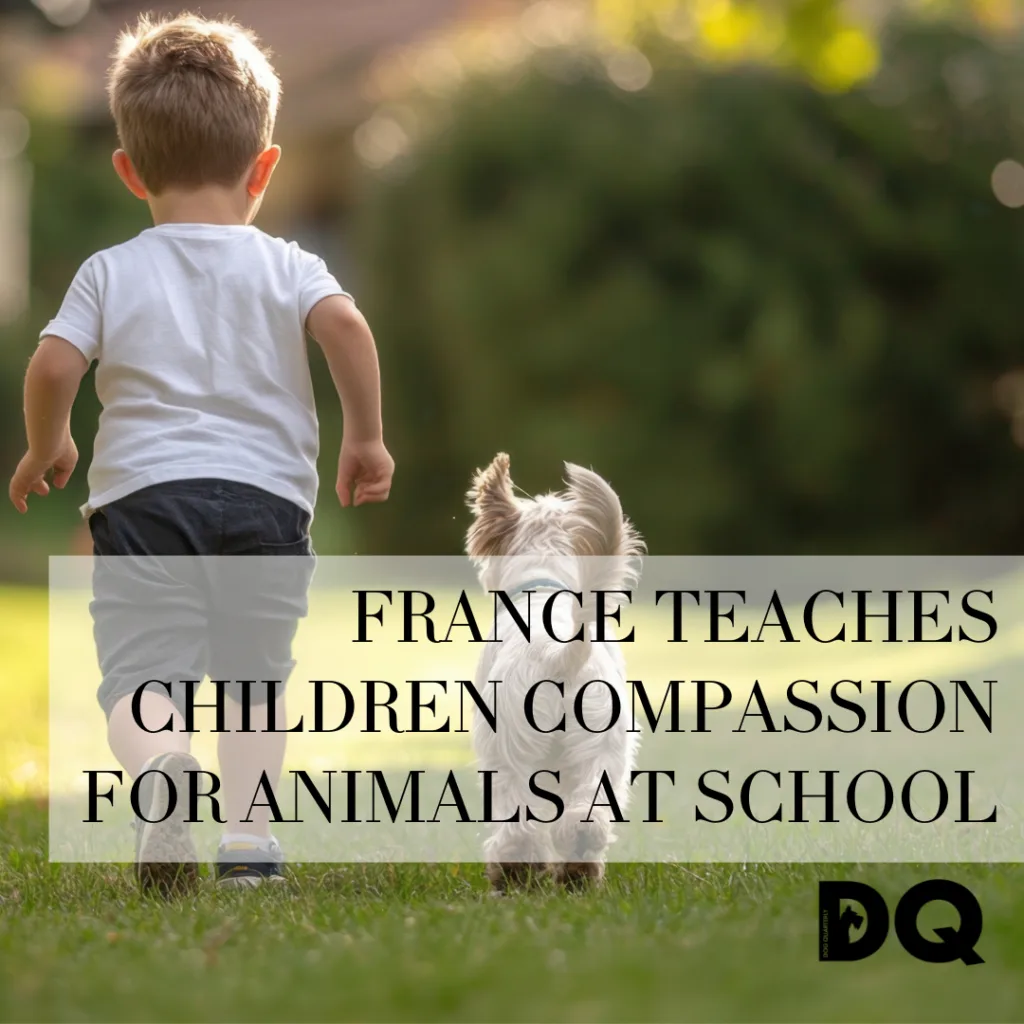
Groundbreaking programme aims to reduce future animal mistreatment by teaching respect and empathy from age five
France has become a pioneer in animal welfare education by incorporating pet care and respect for animals into its national school curriculum – a programme that began in September 2024 and could serve as a model for other nations.
The innovative approach, mandated by the Law of 30 November 2021 on Combating Animal Abuse, requires all primary, middle and high school students to receive education on respecting pets as sentient beings capable of feelings and deserving of compassion.
Starting young: The CP Programme
The programme launched in September 2024 with France’s youngest primary school pupils, those in CP (cours préparatoire, roughly equivalent to Reception in the UK or kindergarten in the US), typically aged five to six years old.
The lessons form part of the children’s “moral and civic education” curriculum, specifically addressing “respect for pets” within the ‘collective rules and autonomy’ skill set confirmed by the French Ministry of Education.
Teachers help pupils to “understand the respect that is due to the environment and to living things, from familiar spaces to more distant ones, which are part of our collective world,” according to La Fondation Droit Animal, Éthique et Sciences (LFDA), an animal welfare group that consulted on the new programme.
More than just pet care
The programme’s scope extends far beyond teaching children how to feed a dog or clean a litter tray. At its heart is a philosophy that understanding animals helps children develop broader life skills and values.
“Teaching animal ethics helps children to acquire essential psychosocial and prosocial skills that benefit humans and other animals,” the LFDA explained.
The foundation emphasised that by understanding animals have their own interests, students learn to tolerate differences – a skill that extends beyond the animal kingdom.
“By understanding that animals have their own interests, students learn to tolerate differences. They will be able to develop compassion for them and apply it to others,” the LFDA stated.
This approach recognises that compassion is not compartmentalised – children who learn to treat animals with kindness and respect are more likely to extend that consideration to people as well.
Preventing future mistreatment
One of the programme’s primary aims is prevention. By teaching children from a young age to recognise animals as sentient beings deserving of respect, France hopes to reduce future cases of animal mistreatment and abandonment.
France has historically struggled with high rates of pet abandonment, with figures suggesting thousands of animals are abandoned each year, particularly during summer holiday periods. The country launched a €20 million action plan against animal abandonment to address this crisis.
The school curriculum represents a long-term investment in changing attitudes and behaviours. Children who grow up understanding that animals feel pain, experience emotions and have their own needs are less likely to mistreat or abandon pets as adults.
Building on secondary education
The CP programme acts as a preparatory foundation for more advanced animal education later in students’ school careers.
Secondary school pupils in France – at collège (middle school) and lycée (high school) levels – already study sections on how to respect pets as sensitive animals, with the aim of preventing pet and animal abuse.
By introducing these concepts at age five and reinforcing them throughout a child’s education, France is creating a comprehensive framework for developing empathy and responsibility towards animals.
Research supports the approach
The French initiative aligns with growing research showing that education about animals benefits children’s development in multiple ways.
The RSPCA’s Animal Kindness Index Report highlights that children who regularly engage with animals are more likely to show kindness and empathy towards both animals and people. Other studies indicate that learning about animal care supports social competencies and emotional regulation in young people.
Research also demonstrates a well-documented link between childhood cruelty to animals and later criminality, violence and anti-social behaviour. Humane education can help break this cycle, replacing it with one of compassion, empathy and personal responsibility.
These benefits extend beyond animal welfare to wider social outcomes, with studies showing positive impacts on bullying reduction, improved school relationships and behaviour, and enhanced academic achievement.
What makes France’s approach notable
France’s programme stands out for several reasons:
Legal mandate: The requirement is enshrined in law (Article 25 of the Law of 30 November 2021), ensuring consistent implementation across the country rather than leaving it to individual schools’ discretion.
National curriculum integration: Pet care and animal respect are not optional add-ons but core components of moral and civic education that all students must receive.
Age-appropriate progression: Starting with young children and building throughout their education creates a sustained, developmentally appropriate learning arc.
Focus on sentience: The programme emphasises that animals are sentient beings, capable of feeling, rather than treating them as objects or resources.
Broader life skills: The curriculum explicitly connects animal welfare to broader values such as tolerance, compassion, and respect for differences.
Part of broader legislative change
The school curriculum forms one component of France’s increased focus on animal protection in recent years.
Changes to French law in 2022 recognised pets as sentient beings rather than objects – a significant shift in legal status that reflects evolving attitudes towards animals.
The national curriculum change ensures that children growing up in France will be educated within this updated framework from their earliest school years, normalising the understanding that animals have feelings and deserve respect.
A model for other countries?
France’s comprehensive approach to teaching animal welfare in schools could provide a template for other nations considering similar initiatives.
Several countries have introduced elements of humane education, but France’s legally mandated, curriculum-integrated approach at the national level represents one of the most thorough implementations to date.
As awareness grows internationally about the benefits of teaching children compassion for animals, France’s experience, including what works well and areas for improvement, will offer valuable lessons.
The broader impact
The programme’s success will ultimately be measured not in test scores but in long-term outcomes: reduced animal abandonment and mistreatment, improved animal welfare standards, and a generation of young people who view animals as sentient beings deserving of consideration and care.
Early research suggests the approach is sound. Children who learn to recognise animals’ feelings, needs and interests develop stronger empathy skills that benefit both animals and human relationships.
By making this education a core component of childhood learning, France is investing in a more compassionate future – one where understanding and respecting the needs of vulnerable beings becomes second nature.
What other countries are doing
Whilst France’s programme is particularly comprehensive, other countries have also recognised the value of humane education:
- The UK has various animal welfare education initiatives, though not mandated nationally in the curriculum.
- Several US states have introduced humane education requirements or recommendations.
- Countries including Germany, Switzerland and the Netherlands have strong animal welfare education components in various forms.
However, France’s legally mandated, nationally standardised approach represents one of the most thorough implementations of humane education at the primary school level.
Looking forward
The programme, now in its second year of implementation, represents a significant commitment to long-term cultural change around animal welfare.
Teachers across France are helping young children understand that the dog down the street, the cat in their home, or the rabbit at school are not just cute, they are feeling, thinking beings whose needs and wellbeing matter.
This simple but profound shift in perspective, taught early and reinforced throughout education, has the potential to reshape France’s relationship with animals for generations to come.
As the LFDA noted, this is a step forward worth celebrating, and perhaps one worth emulating elsewhere.
The French programme forms part of the Enseignement moral et civique (Moral and Civic Education) curriculum. For more information about France’s animal welfare legislation, visit the French Ministry of Education or La Fondation Droit Animal, Éthique et Sciences (lfda.fr).