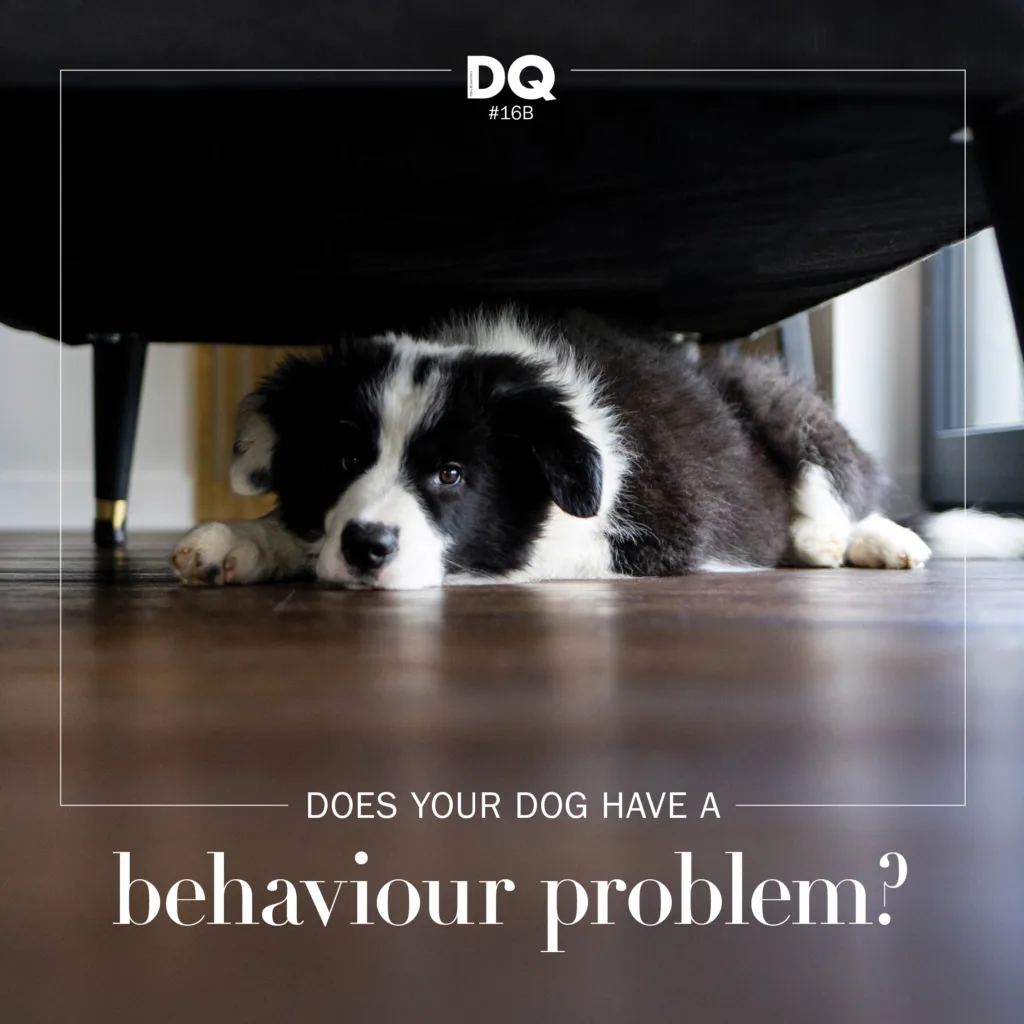
Almost certainly and that’s okay
Here is a statistic that might stop most of us mid-scroll: according to a study published in the Journal of Veterinary Behavior, more than 99% of dogs in the United States display behaviours that could be classified as ‘potentially problematic’.
That number is either alarming or reassuring, depending on how you look at it. If 99% of dogs are doing it, can it really be a problem? And what does it mean for the millions of owners (including us) who feel like they are failing because their dog barks too much, won’t settle around guests, or reacts to other dogs on a lead?
The research
The study was conducted by Dr Bonnie Beaver at Texas A&M University’s College of Veterinary Medicine and Biomedical Sciences, using data from the Dog Ageing Project, the same large-scale, long-running initiative we’ve referred to multiple times in this magazine as the basis for a lot of current research.
Of the dogs included in the dataset:
- 85.9% showed separation and attachment-related behaviours.
- 55.6% displayed some form of aggression.
- 49.9% showed fear and anxiety behaviours.
The top three categories, separation issues, aggression, and fear, are then shown not to be fringe problems affecting a small proportion of ‘poorly trained’ or ‘rescue’ dogs. They are, statistically speaking, the normal experience of the domestic dog.
What does ‘potentially problematic’ mean?
It is worth unpacking the phrase carefully because it does a lot of work in this statistic.
‘Potentially problematic’ does not mean dangerous, disordered, or untreatable. It means behaviours that could cause concern, conflict, or difficulty for the dog, the owner, or others. Pulling on the lead, barking at the neighbours, growling when a stranger reaches over their head, becoming distressed when left alone, cowering at unfamiliar sounds – all of these qualify as potentially problematic, and all of them are remarkably common.
Many of these behaviours are, in fact, entirely natural from a canine evolutionary perspective. Dogs are social animals with strong attachment drives. They communicate through vocalisation and, when communication fails, through the escalating signals that humans often label as aggression. They have evolved finely tuned threat-detection systems that trigger fear and avoidance responses. The problem is not that dogs have these tendencies; it is that our expectations of domestic life often clash with them.
The aggression finding
The 55.6% aggression figure is the one most likely to make owners uncomfortable, and the one most in need of context. Aggression in dogs exists on a spectrum that ranges from a warning growl to a full bite, and the former is both common and, from a welfare perspective, actually desirable.
A dog that growls when he feels threatened is communicating. He is using an appropriate signal in his behavioural repertoire to say: I am uncomfortable, please stop. A dog that has been trained or punished out of growling, one that has learned that his warnings are ignored or met with punishment, is a dog that skips straight to biting, with no warning. The growl is not the problem; suppressing the growl often is.
Did you know?
Children under seven are the most common bite victims, largely because they are least able to read the signals dogs are giving before an escalation.
The normalisation question
There is a delicate balance to strike here with this research. On one hand, recognising that these behaviours are extremely common can provide enormous relief to owners who feel shame, guilt, or hopelessness about their dog’s behaviour. We are not struggling alone, and our dogs are not broken. These are species-typical tendencies playing out in an environment, the human home, that dogs were not entirely designed for.
On the other hand, common does not mean inevitable, untreatable, or acceptable without intervention. Significant separation anxiety causes genuine suffering. Aggressive behaviour that poses a risk to people or other animals needs professional attention. Fear so intense that it prevents a dog from enjoying life is not simply a personality quirk to be accommodated indefinitely.
The goal, then, is not to normalise problematic behaviour as unchangeable, but to remove the stigma that prevents owners from seeking help, and to replace shame with curiosity.
What we can take from this
We are not alone in our concerns. If our dog barks, reacts, clings, or shows a flash of teeth in the wrong moment, we are in the company of virtually every other dog owner on the planet.
Yet, the commonality of the behaviours does not mean we get to ‘ignore’ them. Behaviour is communication. Before trying to stop a behaviour, we need to ask what our dog might be expressing. Fear, pain, confusion, frustration, overstimulation? These are often at the root of the behaviours we find most difficult and are labelled in this research as ‘potentially problematic’. Addressing the cause of these behaviours is more effective and more compassionate than suppressing the symptom.
And as a final reminder, it is worth noting that professional help is for everyone, or at least the owners of these 99% of dogs who show these ‘potentially problematic behaviours’. A certified animal behaviourist or a trainer committed to evidence-based methods is not just for dogs with ‘extreme’ problems. Even dogs with ‘normal’ levels of reactivity, anxiety, or difficult behaviour can make meaningful progress with the right guidance.
Source
Dr Bonnie Beaver, Texas A&M University College of Veterinary Medicine, published in the Journal of Veterinary Behavior, 2025. Data from the Dog Aging Project.