What’s really going on behind a cloudy eye
Not every cloudy eye is a cataract, not every cataract needs surgery, and the drops that promise to dissolve them are overpromising. A clear, evidence-based guide for South African dog owners.
Is my dog going blind, or is it just old age?
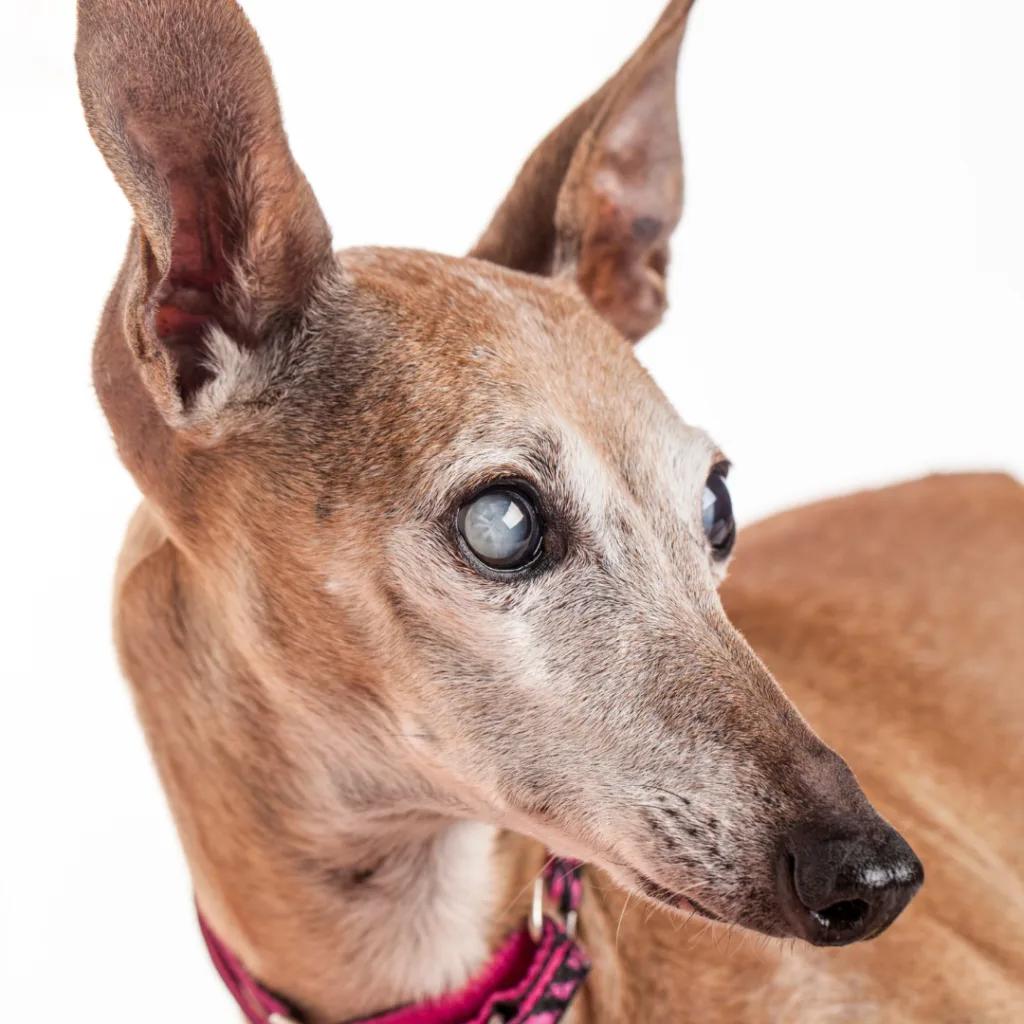
Start here, because the answer is reassuring more often than not. The soft bluish haze that appears in most dogs’ eyes from middle age is usually nuclear sclerosis, a normal hardening of the lens, not a cataract. Light still reaches the retina, so the dog keeps seeing, and nothing needs to be done. A true cataract blocks that light and affects vision.
You cannot reliably tell nuclear sclerosis and a cataract apart from the outside, so a cloudy eye is a reason to have a vet look, not a reason to panic.
What is a cataract, exactly?
The lens normally works like clear glass, focusing light onto the retina. A cataract forms when the lens proteins clump and the glass turns frosted. Vets grade them from incipient (small, vision intact) through immature and mature (the whole lens clouded, effectively blind in that eye) to hypermature (breaking down, with added complications). The stage drives the decisions that follow.
What causes cataracts in dogs?
Two causes matter most.
Inherited cataracts are the commonest form and usually affect both eyes. Many breeds are predisposed, including Poodles, Cocker Spaniels, Boston Terriers, Staffies, French Bulldogs and Siberian Huskies. A DNA test exists for one gene (HSF4), but it only covers a narrow juvenile form in a few breeds, so a clear result is not a guarantee (Mellersh et al., 2006). For breeders, specialist eye screening through the SAVA Eye Certificate Scheme, run with Onderstepoort and recognised by KUSA, is the more reliable safeguard.
Diabetic cataracts are the fastest and most urgent. About 75 per cent of diabetic dogs develop cataracts within a year of diagnosis, and around half within six months (Beam et al., 1999). High blood sugar drives sorbitol into the lens, which swells and clouds, sometimes within days, and good diabetic control does not reliably prevent it. Importantly, do not wait to stabilise the diabetes before addressing the eyes: delaying invites inflammation that can preclude sight-saving surgery.
Inherited and diabetic causes account for most of what vets see, but they are not the only ones. Less commonly, cataracts follow inflammation inside the eye (uveitis) from infection or immune disease, injury or trauma to the eye, or congenital factors, where a puppy is born with cataracts or develops them very young. The cause still matters because it shapes how fast things move and how urgently a specialist is needed.
Does a cataract need to be treated?
Cataracts don’t always need to be treated. The cataract itself is rarely painful, and many dogs adapt well to gradual vision loss. The reason to act is the complications a degenerating lens can trigger, namely lens-induced uveitis, glaucoma and retinal detachment, which are painful and sight-threatening. Watchful monitoring suits some dogs; others, especially diabetics, need prompt referral. Redness, squinting, tearing or rubbing means see a vet now.
Can cataracts in dogs be fixed?
Yes, surgically, and only surgically. Phacoemulsification breaks up and removes the cloudy lens, usually replacing it with an artificial one. Not every dog qualifies: the retina must function, so ophthalmologists first screen with an electroretinogram and often an ocular ultrasound. Success is good and worth stating plainly, commonly around 90 to 95 per cent early on, easing over the years, with real aftercare and a small but genuine complication rate. In South Africa, surgery is available at Onderstepoort and through board-certified ophthalmologists in private specialist practices in Johannesburg and Cape Town. Ask your vet for a realistic cost early. Medical management can control inflammation and protect the eye, but it does not clear the cataract.
Do cataract eye drops work for dogs?
This is where we’d advise being careful with your money. Drops marketed to dissolve cataracts are usually built on lanosterol and N-acetylcarnosine. The lanosterol claims trace to a single 2015 Nature study showing an effect in animal lenses (Zhao et al., 2015), but independent teams could not reproduce it, including later work finding no restoration of lens clarity (Scientific Reports, 2019). N-acetylcarnosine is even less well supported. Tellingly, the more careful products avoid claiming to cure and offer vague support and comfort instead. For a fast-moving diabetic cataract, especially, time on drops is time the eye cannot spare.
What to do next
Have your vet confirm whether you are seeing sclerosis or a cataract. If it is a cataract, the cause sets the urgency, and a diabetic dog should be seen quickly. Surgery is the only real fix and a good one for the right candidate. We’d skip the ‘dissolving’ drops. But, of course, your vet, and where needed a veterinary ophthalmologist, will guide the decision.
References
Beam, S., et al. (1999). Development of cataracts in dogs with diabetes mellitus: 200 cases. Veterinary Ophthalmology.
Mellersh, C.S., et al. (2006). Mutations in HSF4 in dogs with hereditary cataracts. Veterinary Ophthalmology.
Zhao, L., et al. (2015). Lanosterol reverses protein aggregation in cataracts. Nature.
Failure of oxysterols such as lanosterol to restore lens clarity from cataracts. (2019). Scientific Reports.