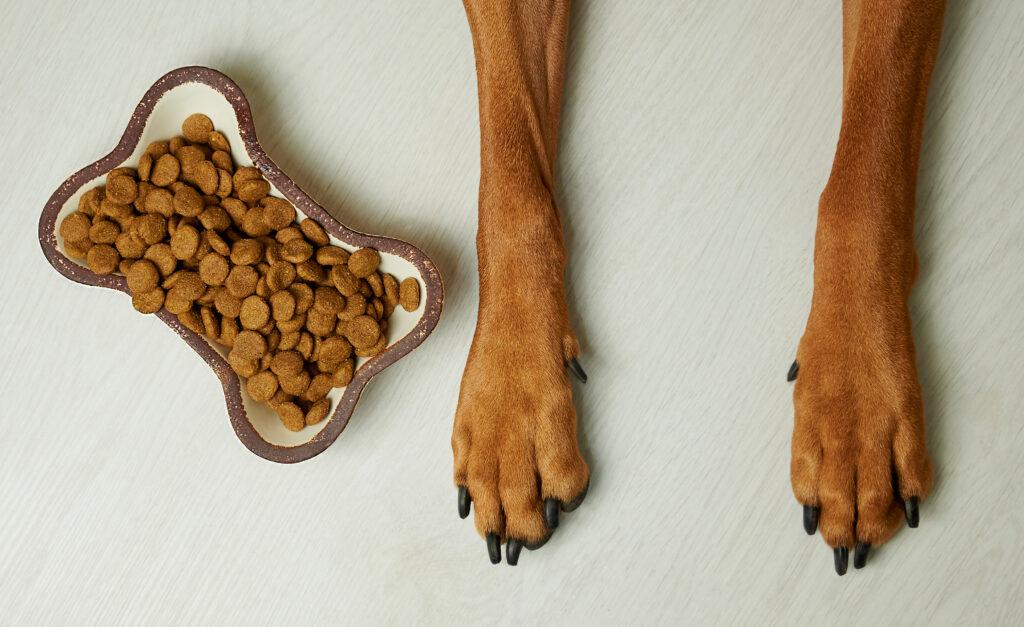
Deep-chested dogs who look slender from above but have a large distance between their backbone and sternum are the most prone to bloat. This means that the top breeds prone to bloat include:
- Great Danes
- Greyhounds
- Boxers
- Weimaraners
- Standard Poodles
- Doberman Pinschers
What is bloat?
Bloat happens when a dog’s stomach fills with gas or food and stretches to the extent that it causes severe pain. When this happens, the stomach bloats but can also twist. This is termed gastric dilatation volvulus (GDV). When the stomach twists in this way, it pulls the entrance (the cardia) and exit of the stomach (pylorus) around so that the stomach is completely obstructed. Contents like food, gas and fluid cannot move in either direction. Furthermore, the spleen is attached to the stomach via small blood vessels, which will also twist. This can lead to blood being trapped in the spleen, causing damage.
A twisted stomach is one of the few true canine emergencies that will always require immediate surgical intervention. If surgery is not performed in time, the stomach will rupture.
What factors increase the risk of bloat?
Some factors that increase the chance of a dog developing bloat include older age, eating too quickly, exercising soon after eating or having a family history of bloat.
Signs and symptoms of bloat
Signs of bloat include the following:
- Your dog’s belly suddenly appears large or feels firm
- Your dog is trying to vomit, but nothing comes out
- Your dog is suddenly restless
- Your dog is in pain
- Your dog salivates heavily
- Your dog has pale gums
If you see any of these signs, you must get your dog to a vet immediately. This will not resolve on its own, and the quicker you get your dog to the vet, the better the prognosis.
NOTE: NEVER assume that because your dog is not one of the breeds listed above, he cannot experience bloat. If you see the signs, assume it is bloat and get him to the vet. Lots of dogs that would be considered to be at very low risk have experienced bloat.
When you get to the vet, you should expect immediate attention. Nothing makes a vet panic quite as much as bloat!
Treatment
The team will start by placing an intravenous catheter to give pain medications and fluids, and oxygen (through a mask) to treat shock, if present. They will organise an X-Ray and perhaps an ultrasound to assess the severity of the condition and determine the next steps. If they see that the stomach has twisted, they will probably trocharise the stomach to relieve the gas distention before heading to theatre. If the stomach is not twisted, just bloated, they will likely administer medications or fluids to reduce the pressure.
Surgery
During surgery, the stomach will be untwisted and placed back into its normal position. Once replaced, the stomach is sewn to the right side of the body wall. This is called a gastropexy. There are several ways to do this surgery, and each surgeon has their own preference. If the stomach has been twisted for too long, some tissue may have died due to the lack of blood flow, and this dead tissue will require removal. This is called gastrectomy. In rare cases, the blood vessels from the spleen will have twisted so much that the spleen must also be removed (splenectomy).
After surgery, you can expect your dog to be hospitalised for one to three days to recover. During this period, IV fluids, pain medications and other treatments will be administered. Heart arrhythmias are a common complication after the operation, and the vet will monitor for this and treat it as needed. Sometimes, a patient may go home on heart medication, but this is usually discontinued after full recovery.
Prognosis
Previously, most dogs with a twisted stomach secondary to bloat died. Now with rapid identification and treatment, the prognosis is quite good, with up to 80-90% of dogs recovering after surgery. Gastropexy will prevent further twists in 90% of patients. However, because it doesn’t fully prevent recurrence, any dog with a history of bloat should always be monitored for symptoms.
Note:
Bloat often occurs in the evening after the dog’s meal. Why this happens is poorly understood.
Prevention
If you have a large or deep-chested breed, gastropexy, which attaches the stomach to the body wall to prevent it from twisting, is often recommended at the same time as a spay, neuter or other surgical procedure.