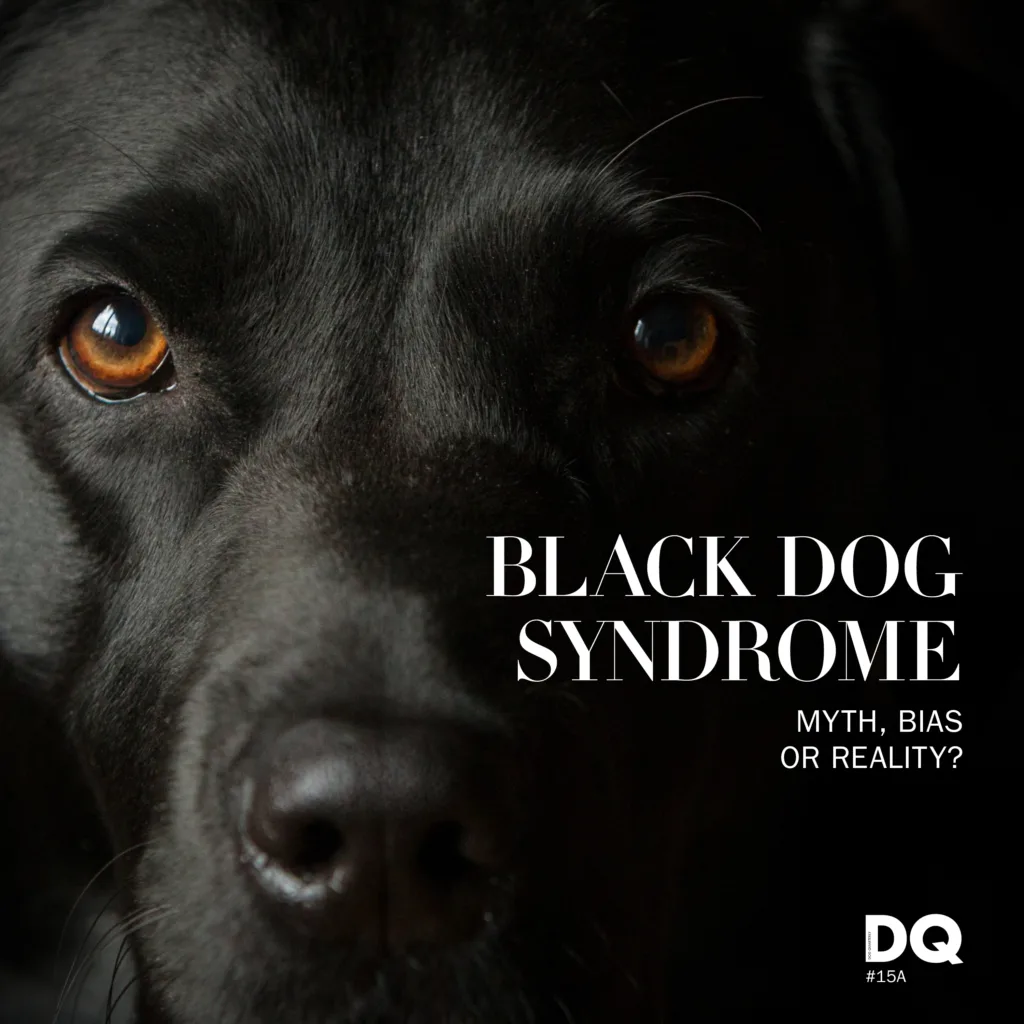
Myth, bias or reality?
For decades, shelters across the world have spoken about ‘black dog syndrome’. This is the idea that black dogs are adopted less often, wait longer for homes, and are more likely to be euthanised. But is this really true, or is it simply an echo of a narrative that has been repeated long enough to feel factual?
The short answer: it’s complicated.
The long answer: it’s rooted in human psychology, shelter environments, and unconscious bias more than anything the dogs themselves do.
Let’s unpack it.
Is black dog syndrome real?
The data says: partly yes, partly no
Several studies (including analyses from US shelters, UK rescues and Australian adoption data) show a consistent pattern:
- Black dogs often have longer shelter stays than lighter-coloured dogs, especially compared to ‘standout’ colours like merle, cream, tan or spotted coats.
- Large black dogs, especially mixed breeds, remain the hardest to home.
- But smaller black dogs and those with unusual features (scruffy coats, bright eyes, distinctive markings) do not show the same trend.
So the syndrome isn’t universal…
But for large, plain-coated black dogs?
Yes, it’s still very much a thing.
Why does this happen? The psychology behind the bias
1. They’re harder to photograph in shelters
Dark fur in low light disappears against background shadows leading to:
- photos where the dog looks expressionless
- indistinct features
- ‘all the photos look the same’ syndrome
Good photography dramatically increases adoption interest.
2. Unconscious bias plays a role
Studies in human perception show that people often (without realising it) associate dark colours with:
- seriousness
- intensity
- anxiety triggers
- ambiguity
This spills over into how people interpret dog faces.
3. Facial features don’t stand out as easily
Shelter visitors naturally look for:
- eye contact
- facial expression
- ‘softness’ in the face
Black dogs’ eyes and expressions are harder to read from a distance, especially in dim kennels.
4. Pop culture hasn’t helped
Media tropes equate:
- black animals = mysterious
- big black dogs = scary
- wolves/dark canines = villains
Even if we know better, these associations live quietly in the subconscious.
5. Shelter environments disadvantage dark dogs
Concrete buildings and poor lighting and bars and shadows amplify the issue.
The same dog looks completely different in natural daylight.
So what’s the truth?
Is there something ‘wrong’ with black dogs?
Absolutely not.
Black dogs are not:
- more aggressive
- more anxious
- less intelligent
- less friendly
- harder to train
They’re simply victims of perception, not behaviour.
How adopters can help
1. Look past the shadow
Meet the dog outside the kennel. Let them show who they actually are. And remember, appearance is only ‘fur deep’.
2. Ask for natural-light photos or videos
Shelters are often happy to send these. You’ll see the ‘real dog’ more clearly.
3. Remember: temperament > colour
Every behaviourist will tell you: Coat colour has zero impact on personality.
4. If you’re drawn to ‘overlooked dogs’; this is your moment
Choosing the dog who always gets passed over may be the most meaningful adoption you ever make.
The bottom line
Black dog syndrome is not superstition; it’s a mix of camera physics, shelter lighting, psychology, and human bias.
We can remedy it by focusing on the beauty of the dogs that no one notices at first glance. The ones waiting longer. The ones who deserve better.