If you’ve ever attended an all-breed dog show, you might picture a polished handler trotting a dog around a ring before a judge points to the winner. German Shepherd Dog (GSD) breed shows are a different world entirely. Run under the system developed by the Verein für Deutsche Schäferhunde (SV) – the breed’s parent organisation in Germany – these specialist shows evaluate the whole dog: structure, movement, temperament, and working ability. In South Africa, the German Shepherd Dog Federation (GSDFSA) is the recognised WUSV member body that administers this system.
The breed’s standard has been shaped over more than a century. Methodical breeding began in 1899, when the SV was founded with the goal of creating a working dog capable of high achievement. Central and southern German herding dogs were consolidated into the breed we know today, and every element of the official standard – from angulation to temperament – traces back to that original working purpose.
This guide explains how SV-style breed shows work, what the different classes and ratings mean, and what judges are evaluating against the official FCI Breed Standard (Standard N° 166), whether you’re a prospective exhibitor, a breed enthusiast, or simply a curious spectator.
Not your average dog show
In a typical all-breed show, a judge selects a ‘Best in Show’ after comparing the top dogs from each breed group. GSD breed shows don’t work that way. Instead of competing against other breeds, every German Shepherd is measured against a single benchmark: the FCI Breed Standard (Standard N° 166), maintained by the SV and recognised worldwide. The standard describes the ideal German Shepherd in precise terms – physical constitution, traits, and characteristics – and the judge’s task is to evaluate how closely each dog conforms to it.
Perhaps the most important distinction is the inclusion of a working assessment. The FCI classifies the German Shepherd as a Group 1 Sheepdog with working trial, and the standard itself describes the breed’s utilisation as a “versatile working, herding and service dog.” For adult dogs in the Working Classes, a protection work phase is mandatory. A beautiful dog that lacks courage or temperament cannot achieve the highest ratings.
Show classes and age groups
Dogs are separated by sex (females are judged first, then males) and by coat variety. The FCI standard recognises two coat types: Double Coat (Stockhaar) with dense, harsh, close-fitting guard hair, and Long and Harsh Outer Coat (Langstockhaar) with longer, softer guard hair that forms tufts on the ears, bushy trousers, and a mane-like covering at the neck. Both must have an undercoat. Dogs of each coat variety are shown in separate classes.
Within each division, dogs are grouped by age:
| Class | Age | What to know |
| Baby Puppy | 3–6 months | The youngest entrants. Judged gently on promise and basic type. A wonderful introduction to the show ring. |
| Junior Puppy | 6–9 months | Starting to show breed characteristics. Judges look for sound early development. |
| Senior Puppy | 9–12 months | More developed structure becomes evident. Ratings of Very Promising (VP), Promising (P), or Less Promising (LP) are awarded. |
| Youth | 12–18 months | Adolescent dogs showing more mature movement and conformation. |
| Young Dog | 18–24 months | Nearly adult. These classes carry ratings of Very Good (SG), Good (G), Sufficient (A), or Insufficient (U). |
| Open | 24+ months | Adult dogs without working titles. Placed in order of quality but no formal ratings are awarded. |
| Working Dog | 24+ months | The premier classes. Dogs must hold a recognised working title (e.g., IGP) and pass protection work at the show. |
The rating system: V, SG, G and more
Unlike shows that simply place dogs first through last, SV-style shows use a grading system rooted in German terminology. Each dog receives both a rating (grade) and a placement within that rating. For example, a dog placed third among those rated Excellent would be designated V3 (Vorzüglich 3). The key ratings for adult Working Classes are:
- VA (Vorzüglich-Auslese / Excellent Select): The highest honour, reserved for National-level shows when an SV judge officiates. Only the very best dogs that fully conform to the standard, demonstrate outstanding character, and hold a current breed survey qualify.
- V (Vorzüglich / Excellent): Dogs that fully conform to the breed standard, are confident, settled in temperament, and have passed both the gun-steadiness test and protection work assessment.
- SG (Sehr Gut / Very Good): The highest rating available in Youth and Young Dog classes. In the Working classes, this goes to dogs with minor anatomical faults.
- G (Gut / Good): Dogs that generally conform to the standard but show clearly observable faults.
- A (Ausreichend / Sufficient): Dogs with significant faults that nonetheless meet minimum standards.
- U (Ungenügend / Insufficient): Dogs that do not meet the minimum requirements.
For puppies, the equivalent system uses VP (Very Promising), P (Promising), and LP (Less Promising). The winner of each class is known as the Sieger (male) or Siegerin (female), the German word for champion.
How judging works in practice
Individual stand-for-examination
Each dog is presented individually to the judge, who examines its structure while the dog is ‘stacked’ (posed). The judge checks dentition – the standard requires a full complement of 42 teeth in a correct scissor bite, where the upper incisors closely overlap the lower incisors. Deviations such as overshot, undershot, or level bites are faults, and missing certain teeth can be disqualifying. Wither height and chest depth are measured and verified against the standard’s specifications. Dogs 12 months and older are also tested for gun steadiness.
Gaiting
This is where the German Shepherd’s hallmark movement comes alive. The FCI standard is emphatic: the GSD is a trotter. Dogs gait around the ring at an extended trot, often for prolonged periods, while the judge assesses ground-covering reach, drive from the hindquarters, firmness of the back and ligaments, and overall endurance. The standard describes the ideal gait as ‘far-reaching and flat over the ground,’ conveying an impression of effortless forward movement. With the head pushed forward and tail slightly raised, the dog should display a smooth, uninterrupted upper line from the ear tips, over the neck and back, to the tip of the tail. Handlers run alongside their dogs – fitness matters for humans too!
Protection work
For Working Dog classes, the protection work assessment is a core component. A trained helper wearing a protective sleeve tests the dog’s courage, grip strength, willingness to engage, and its ability to release on command. This demonstrates both drive and controllability. The breed standard requires the GSD to possess “instinctive behaviour, resilience and self-assurance” to be suitable as a protection and service dog, and this test is where those traits are proven in practice. Dogs that show nerves, fear, or uncontrollable aggression cannot achieve the top ratings; indeed, ‘weak character’ combined with biting is listed as a disqualifying fault in the standard itself.
The FCI Breed Standard: What judges are looking for
The official FCI Standard N° 166 is the blueprint against which every German Shepherd is measured. Here is what the judge evaluates across the key areas of the standard:
General appearance and proportions
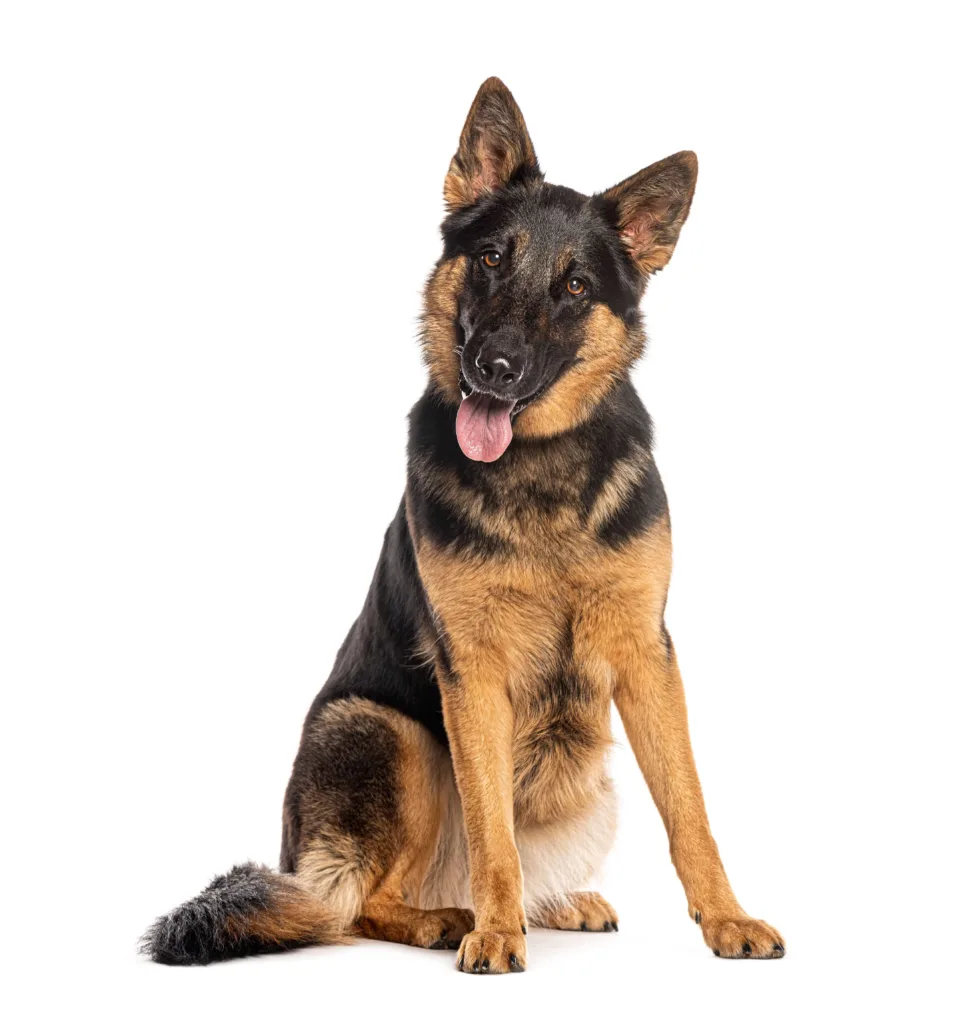
The GSD should be medium-sized, slightly elongated, powerful and well-muscled, with dry bone and a firm overall structure. Males stand 60–65 cm at the wither and weigh 30–40 kg; females stand 55–60 cm and weigh 22–32 kg. The trunk length exceeds the height at the withers by approximately 10–17%, giving the breed its characteristic slightly rectangular silhouette. Dogs that are oversize or undersize by more than 1cm face disqualification.
Character and temperament
Character is not a soft consideration in GSD judging; it is central. The standard calls for a dog that is well-balanced with strong nerves, self-assured, and absolutely natural. Outside of stimulated situations, the GSD should be good-natured, attentive, and willing to please. The dog must demonstrate resilience and self-assurance sufficient for roles as a companion, guard, protection, service, and herding dog. This combination of approachability with alertness is what separates the correct GSD temperament from dogs that are either nervous or indiscriminately aggressive.
Head
The head should be wedge-shaped and proportionate to the body, with its length being approximately 40% of the height at the withers. The cranial-to-facial region ratio is 50:50. Key features include a straight nasal bridge (any dip or bulge is undesirable), taut and dark-coloured lips, and a black nose in all colour varieties. The eyes should be medium-sized, almond-shaped, slightly slanted, and as dark as possible – light or piercing eyes are specifically penalised. The ears are erect, medium-sized, pointed, and carried upright with the auricle facing forward. Tipped or drooping ears are faulty.
Dentition
The teeth must be strong, healthy, and complete: 42 teeth according to the dental formula, meeting in a scissor bite. This is one of the areas most carefully checked during the stand-for-examination. The jaw bones must be sufficiently developed for the teeth to sit deeply in the dental ridge. Deviations from the scissor bite, overshot of 2 mm or more, undershot, level bite across the entire incisor region, or missing certain teeth (such as a canine, a premolar 4, a molar 1 or 2, or three or more teeth in total) are disqualifying faults.
Body and structure
The neck should be strong and well-muscled, set at approximately 45° to the horizontal, without loose skin or dewlap. The upper line runs from the base of the neck over high, long withers, through a straight, firm back, and into a slightly sloping croup (approximately 23° to the horizontal), merging smoothly into the base of the tail. The back must be moderately long, firm, strong, and well-muscled; the loin broad, short, and strongly developed. The chest should be moderately broad, with depth amounting to approximately 45–48% of the height at the withers. Barrel-shaped chests and flat ribs are equally faulty.
The tail extends at least to the hock but not beyond the middle of the hind pastern. It hangs in a gentle curve at rest and rises when the dog is excited or moving, but should not be carried above the horizontal.
Angulation and limbs
Correct angulation is what underpins the GSD’s famous gait. The shoulder blade and upper arm should be of equal length, with an ideal angulation of 90° (generally up to 110°). Forelimbs must be straight and absolutely parallel from the front. The pastern sits at a 20–22° angle to the forearm – too steep or too slanted compromises working stamina.
In the hindquarters, the upper and lower thigh are of approximately equal length, forming an angle of around 120°. The standard specifically warns that over-angulation of the hindquarters reduces stability, stamina, and therefore working ability. Hocks must be strongly developed and firm, with the hind pastern standing vertically beneath them.
Movement
Movement is arguably the single most important element in GSD judging, and it is where correct proportions and angulation are proven. The limbs must be coordinated in length and angles so that the hindquarters can drive powerfully toward the trunk while the forequarters reach correspondingly far forward, all without disturbing the topline. The result should be a far-reaching, ground-hugging trot that looks effortless. This is why the gaiting phase in the show ring often runs for extended periods; the judge is testing not just the correctness of movement but the endurance, the very quality that made these dogs invaluable as tireless herding companions.
Coat and colour
Accepted colours include black with reddish-brown, brown, or yellow to light grey markings, single-coloured black, and grey with darker shading and a black saddle and mask. Small white marks on the chest are permissible but not desirable. The tip of the nose must be black in all colour varieties. Dogs with weak pigmentation – lacking a mask, pale nails, light eye colour, or a red tip of tail – are penalised. White coat colour is a disqualifying fault, as is any coat that lacks an undercoat.
Faults and disqualifications
The standard operates on a proportional fault system: any departure from the ideal is considered a fault, and its severity is judged by its degree and its effect on the dog’s health and working capability. Serious faults include ears set too low or not firm, considerable pigment deficiencies, and severely impaired overall stability. Disqualifying faults include dogs with weak character that bite, physical or behavioural abnormalities, missing key teeth, jaw defects such as being overshot by 2 mm or more, over- or undersized by more than 1 cm, albinism, white coat colour, and coats without an undercoat. Male dogs must have two apparently normal, fully descended testicles.
Progeny Groups and Kennel Groups
Two special presentations set SV-style shows apart from conventional formats. Progeny Groups showcase a stud dog alongside a minimum of six of his offspring, allowing the judge and audience to see the consistency and quality a sire produces. This is invaluable for assessing breeding value as the measure of a stud dog is not just his own conformation, but what he consistently passes on.
Kennel Groups consist of three to five dogs bred under the same kennel name. They must include animals from at least two different sires and two different dams, and each dog must have achieved a minimum rating of Good. This presentation demonstrates the depth, vision, and consistency of a breeding programme over time. These groups are often the emotional highlight of a National show as seeing a breeder’s life’s work lined up together is a powerful sight.
The GSDFSA and its role
The German Shepherd Dog Federation of South Africa was founded in 1984 (formally constituted in 1985) as a specialist registering authority dedicated exclusively to the German Shepherd Dog. It is the only South African body recognised by both the SV and the World Union of German Shepherd Dog Associations (WUSV), which encompasses over 80 member countries.
The Federation oversees breed registration, hip and elbow screening, breed surveys, working trials (IGP), and the network of regional clubs where training and socialisation take place. Its annual National Breed Show (NBS) is the pinnacle of the South African GSD calendar, attracting entries from across the country and featuring internationally accredited SV judges from Germany. The show spans an entire weekend, with protection work, individual class judging, and the grand presentations of Progeny and Kennel Groups.
Attending as a spectator
GSD breed shows are open and welcoming to spectators. Here are a few tips for getting the most out of your visit:
- Arrive early. Judging begins promptly, and the puppy classes at the start of the day are a crowd favourite.
- Watch the Working Dog classes. The protection work is the most dramatic and unique element; you won’t see this at a regular dog show.
- Listen to the critiques. Judges provide verbal assessments of each dog. Even when delivered in German with translation, these are highly educational and help you understand what the judge values.
- Talk to exhibitors. The GSD community is passionate and generally happy to answer questions between classes. Most breeders love sharing their knowledge about the breed.
A breed apart
The SV-style breed show is more than a beauty contest. It is a structured evaluation system designed to ensure that the German Shepherd Dog remains what its founder, Max von Stephanitz, intended: a versatile, sound, and courageous working dog. Every element – from the teeth check to the endurance trot to the courage test – serves a purpose in maintaining the breed’s integrity for future generations.
Whether you’re ringside at the National Breed Show this weekend at KPC, watching the livestream, or visiting a regional club event later in the year, understanding the FCI standard and the SV system gives you a far richer appreciation of what you’re seeing. These dogs aren’t just being judged on how they look; they’re being evaluated on whether they can do what a German Shepherd Dog was born to do.
The full FCI Breed Standard (Standard N° 166) is available from the German Shepherd Dog Federation of South Africa at gsdfederation.co.za
Join us at Kyalami Park Club this weekend in Johannesburg to watch the GSDFDS National Breed Championships in action (25th – 27th April 2026).